Projects

A website for studying better powered by AI and MERN stack
Recently, I have been developing a website for active recall learning. You can upload ANKI, CSV, or PDF files, use AI agents such as OpenAI GPTs, Google Gemini, or Claude, or create flashcard decks manually. You also are able to share your decks with your friends, enjoy the website using mobile, or desktop, and review your decks based on the difficulty of each cards.
Productivity Project Oct 2025
activerecaller.com
RePAIR Project
The main goal of RePAIR project is to develop a ground-breaking technology to virtually eliminate one of the most labour intensive and frustrating steps in archaeological research, namely the physical reconstruction of shattered artworks. Indeed, countless vases, amphoras, frescos and other ancient artefacts, all over the world, have not survived intact and were dug out from excavation sites as large collections of fragments, many of which are damaged, worn out or missing altogether.
Introduction to Machine Learning Sep 2024
Run Source
Article Reading Automation
I started to read new articles on a daily basis. I made an automation using n8n, Google Gemini, Postgres, and a website using Fast-API that made this more productive, and time efficient. I would appreciate if you check it out and give me feedback, to make it better. If you are interested in using n8n automation, contact me to launch one for you. ;)
Productivity Project Oct 2025
Visit Download n8n file
Semi-Supervised SVM vs Newton Universum Twin SVM
In this project, we implemented two models: the Semi-Supervised SVM (S3VM) and the Newton-based Universum Twin SVM (Newton-UTSVM). S3VM strengthens learning with unlabeled data, while Newton-UTSVM improves generalization using Universum data. After comparing their performance, we propose a new method—the Unconstrained S3VM—that combines the advantages of both approaches for a more flexible solution.
Introduction to Artificial Intelligence Apr 2023
Report Run Source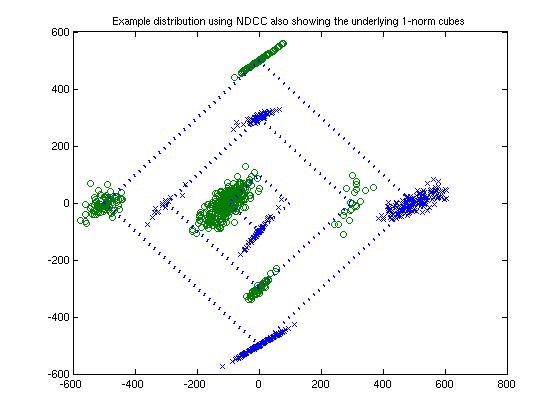
Multi-Class Normally Distributed Cluster Centers Data Generator
NORMALLY DISTRIBUTED CUBIC CLUSTERS is a data generator. It generates a series of random centers for multivariate normal distributions. NDC randomly generates a fraction of data for each center, i.e. what fraction of data points will come from this center. NDC randomly generates a separating plane. Based on this plane, classes for are chosen for each center. NDC then randomly generates the points from the distributions. NDC can increase inseparability by increasing variances of distributions. A measure of "true" separability is obtained by looking at how many points end up on the wrong side of the separating plane. All values are taken as integers for simplicity.
Hossein Moosaei, Saeed Khosravi, Dave Musicant Jul 2020
Run Source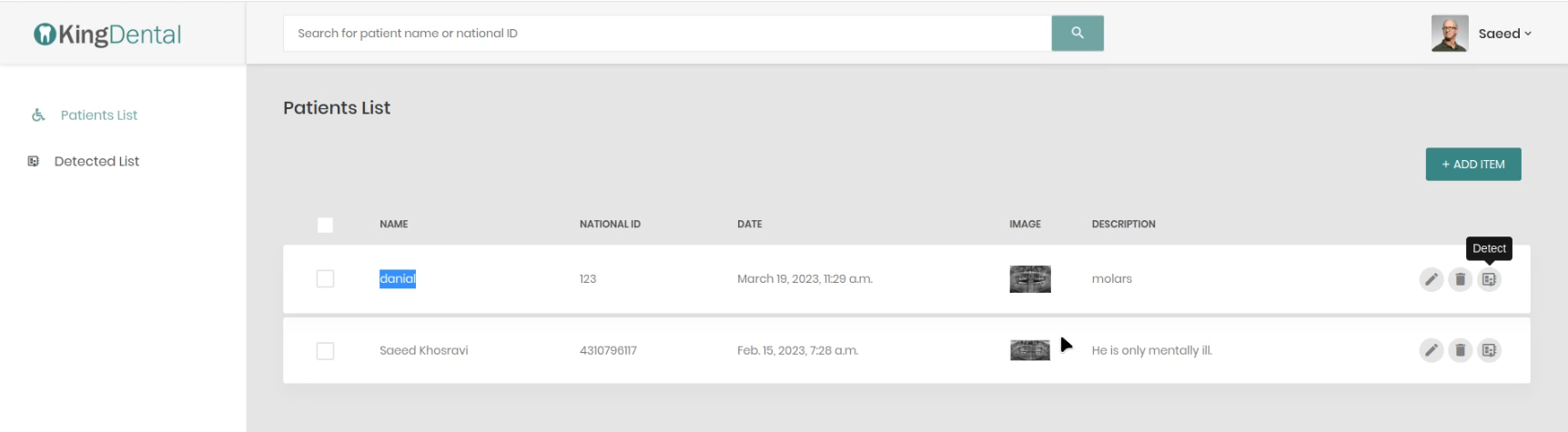
Dental Assistant Project
Implemented a panel for dentists to set patients records and X-rays images, and used an AI model to detect decayed and damaged teeth or teeth that may be at risk of future decay of patients and reports these findings to the dentist so they can provide the necessary care.
Python, Django, PyTorch Feb 2023
Source